Article

Identifying the causal allele in the CD40 autoimmune locus enables discovery of context-specific trans-effects in B cells

Thousands of genetic variants are associated with autoimmune diseases, but causal variants, their mechanisms, and the pathogenic context in which they act are elusive. Knowledge of …

Yoshihiko Tomofuji
•
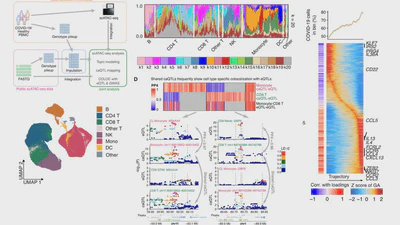
Impact of disease-associated chromatin accessibility QTLs across immune cell types and contexts featured image

Impact of disease-associated chromatin accessibility QTLs across immune cell types and contexts

Human genetics has emerged as one of the most dynamic areas of biology, with a broadening societal impact. In this review, we discuss recent achievements, ongoing efforts, and …

avatar
Zepeng Mu
•
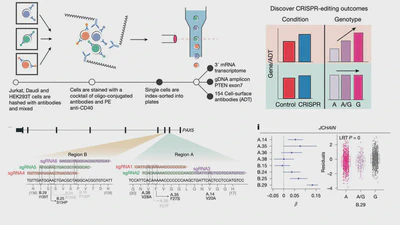
Precisely defining disease variant effects in CRISPR-edited single cells featured image

Precisely defining disease variant effects in CRISPR-edited single cells

Genetic studies have identified thousands of individual disease-associated non-coding alleles, but the identification of the causal alleles and their functions remains a critical …

Yuriy Baglaenko
•

A multi-tissue, splicing-based joint transcriptome-wide association study identifies susceptibility genes for breast cancer

Splicing-based transcriptome-wide association studies (splicing-TWASs) of breast cancer have the potential to identify susceptibility genes. However, existing splicing-TWASs test …

Guimin Gao
•

Epigenetic variation impacts individual differences in the transcriptional response to influenza infection

Humans display remarkable interindividual variation in their immune response to identical challenges. Yet, our understanding of the genetic and epigenetic factors contributing to …

Katherine a Aracena
•
The impact of cell-type and context-dependent regulatory variants on human immune traits featured image

The impact of cell-type and context-dependent regulatory variants on human immune traits

Background: The vast majority of trait-associated variants identified using genome-wide association studies (GWAS) are noncoding, and therefore assumed to impact gene regulation. …

avatar
Zepeng Mu
•

Alignment of single-cell RNA-seq samples without over-correction using kernel density matching

Single-cell RNA sequencing (scRNA-seq) technology is poised to replace bulk cell RNA sequencing for most biological and medical applications as it allows users to measure gene …

Mengjie Chen
•

Haplotype-resolved diverse human genomes and integrated analysis of structural variation

Long-read and strand-specific sequencing technologies together facilitate the de novo assembly of high-quality haplotype-resolved human genomes without parent–child trio data. We …

Peter Ebert
•

Clinical and genome-wide analysis of serum platinum levels after cisplatin-based chemotherapy

**Purpose**: Serum platinum is measurable for years after completion of cisplatin-based chemotherapy (CBC). We report the largest investigation of serum platinum levels to date of …

Matthew R Trendowski
•

A genetically engineered Escherichia coli that senses and degrades tetracycline antibiotic residue

Due to the abuse of antibiotics, antibiotic residues can be detected in both natural environment and various industrial products, posing threat to the environment and human health. …

avatar
Zepeng Mu
•